What should your doctor cover with you?
NICE, the UK guideline body, says that for people 40 and over, your doctor should go through the benefits and risks of each option and, if you choose HRT, how long and what reviews involve.
Every option, with pros and cons
For people 40 and over, NICE says your doctor should go through the benefits and risks of each possible way to manage your symptoms. HRT is one choice. Menopause-specific CBT is another.
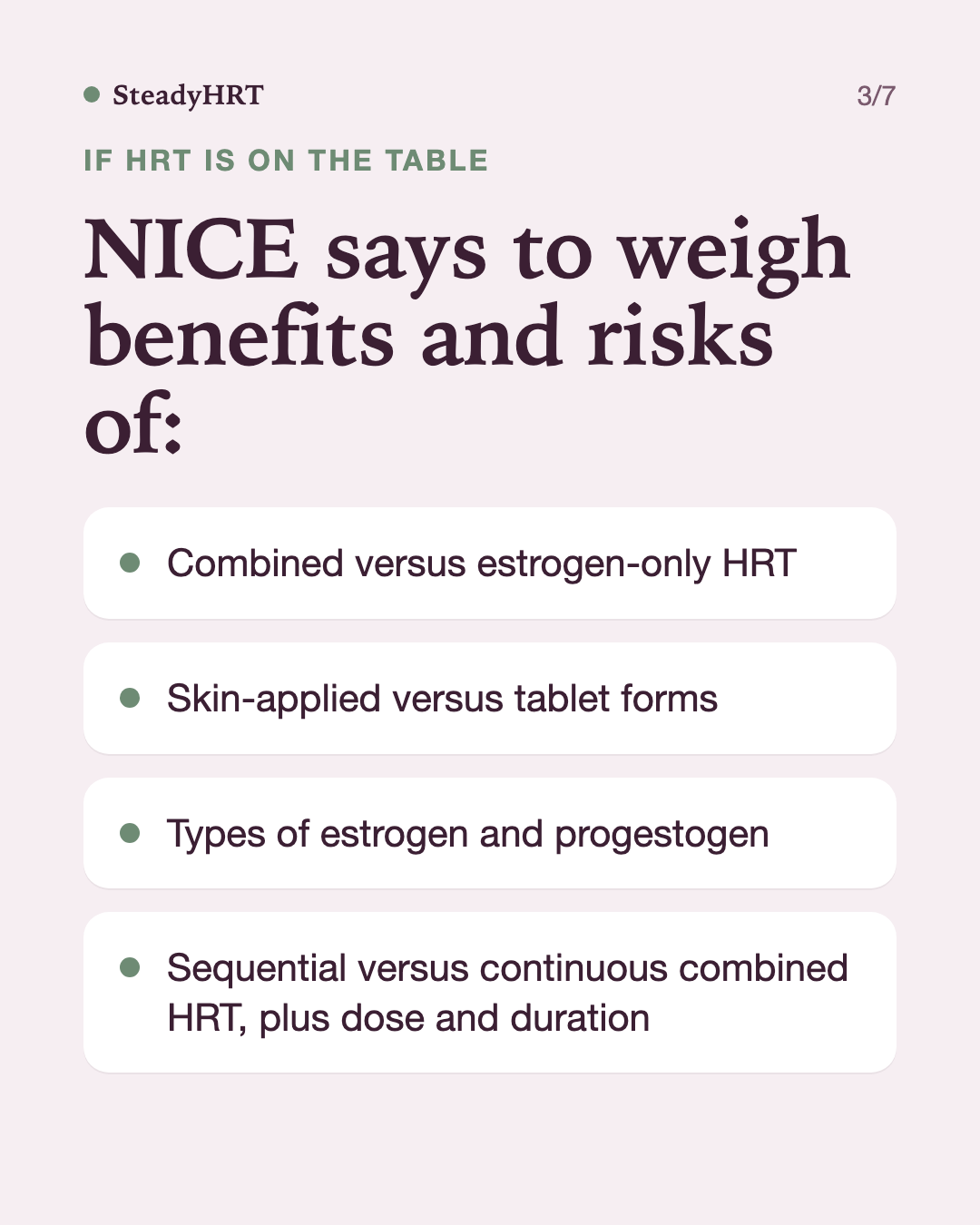
NICE says to weigh benefits and risks of:
- Combined versus estrogen-only HRT
- Skin-applied versus tablet forms
- Types of estrogen and progestogen
- Sequential versus continuous combined HRT, plus dose and duration
Duration, reviews and stopping
NICE says that if you choose HRT, how long you might take it should come up at the outset. Benefits and risks of continuing get rediscussed at every review. Symptoms may return when HRT is stopped, and restarting can be discussed.
Bone health is part of the talk
NICE says people experiencing menopause should be given advice on bone health. It should be discussed again at review appointments.
Ask about unregulated products
NICE says doctors should explain that the safety, quality and purity of unregulated preparations may be unknown. NICE also says doctors should explain that the effectiveness and safety of unregulated hormone products are unknown.
Questions for your doctor
- How do the pros and cons of each choice apply to me?
- What will we look at when we review my treatment?
- If I choose HRT, what happens to my symptoms if I stop later?
As slides

Sources
- NICE (UK) NG23, Menopause: identification and management: www.nice.org.uk/guidance/ng23/chapter/Recommendations
General information, not medical advice.